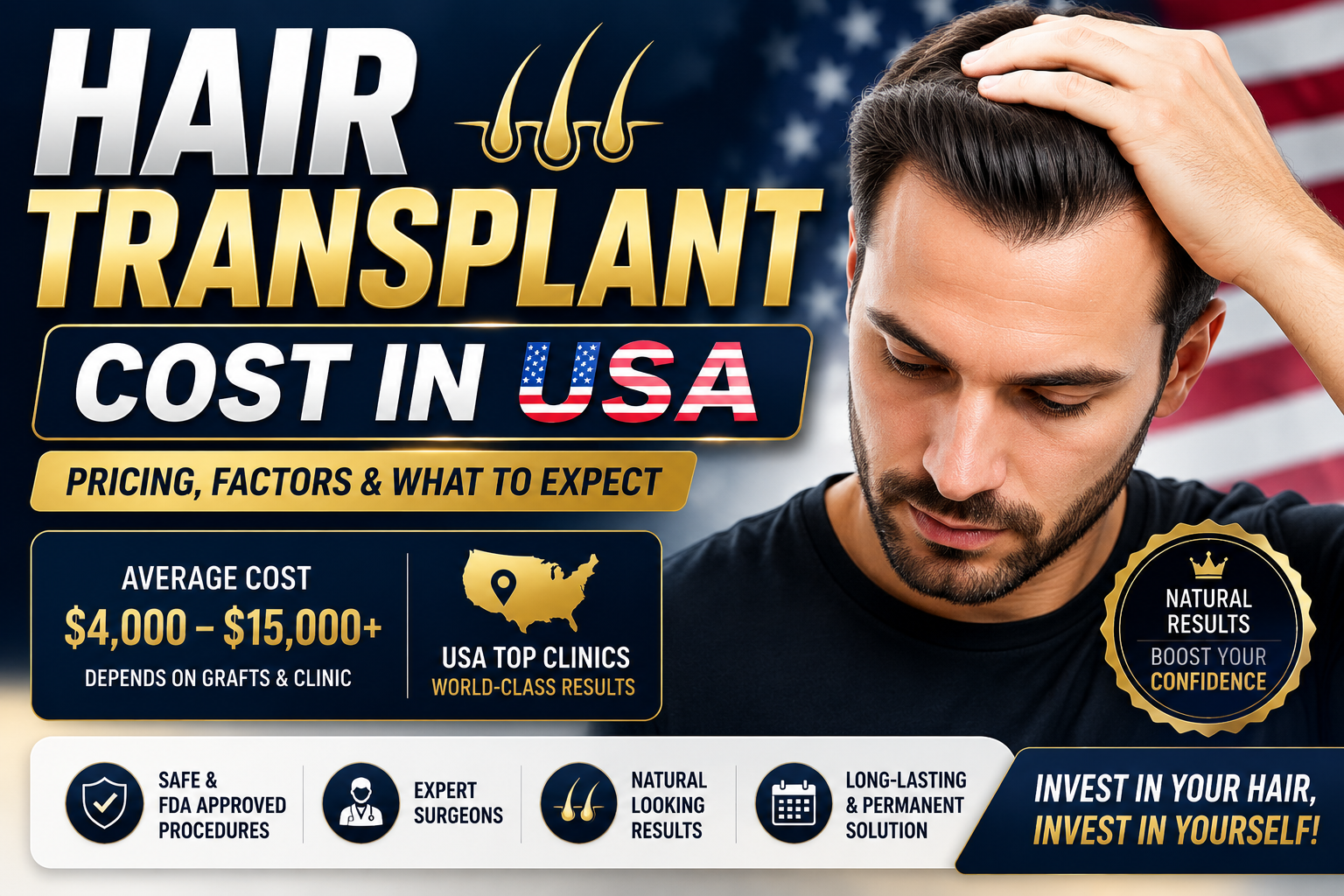
Hair Transplant Cost in the USA (2026): The Complete Pricing Guide You Actually Need
By a Hair Restoration Expert | Last Updated: June 2026 | Reading Time: 12 Minutes
If you’ve been Googling “how much does a hair transplant cost in the USA,” you already know the answers vary wildly — from vague ranges to clinic-specific quotes that feel like car dealership pricing. This guide cuts through all of that.
Whether you’re a first-time researcher or someone who has already scheduled a consultation, what follows is the most thorough, up-to-date breakdown of hair transplant costs in America — covering every technique, every influencing factor, city-by-city price differences, financing options, and the questions you should absolutely be asking before you hand over a single dollar.
Let’s get into it.
What Is the Average Cost of a Hair Transplant in the USA?
The short answer: most Americans pay between $6,000 and $15,000 for a hair transplant in 2026, with a national average hovering around $8,000 to $12,000 for a standard procedure. However, depending on the clinic, technique, surgeon, and geographic location, total costs can range anywhere from $4,000 on the lower end to well over $25,000 for advanced, multi-session cases.
Here is what the data tells us:
| Procedure Type | Average Cost Range (USA, 2026) |
|---|---|
| FUT (Strip Method) | $4,000 – $10,000 |
| FUE (Standard) | $7,000 – $15,000 |
| Sapphire FUE | $7,500 – $16,000 |
| DHI (Direct Hair Implantation) | $8,000 – $16,000 |
| Robotic / AI-Assisted FUE | $10,000 – $25,000+ |
| Exosome-Enhanced FUE | $10,000 – $18,000 |
These figures reflect the complexity of the hair restoration industry: it is not a one-size-fits-all market, and pricing reflects skill, technology, artistry, and real medical expertise.
How Is Hair Transplant Pricing Actually Calculated?
Before you can budget intelligently, you need to understand how clinics arrive at a number. There are two primary pricing models in the U.S. market.
Per-Graft Pricing (Most Common in the USA)
The majority of American clinics charge by the graft — meaning each individual follicular unit you receive has a price tag. In 2026, per-graft rates typically fall in this range:
- FUT: $3 – $7 per graft
- Standard FUE: $5 – $10 per graft
- DHI: $5.50 – $8 per graft
- Sapphire / Premium FUE: $6 – $10+ per graft
So if your surgeon determines you need 2,500 grafts of standard FUE at $6 per graft, your procedure cost comes to $15,000 — before accounting for any add-ons, consultations, or follow-up care.
Many clinics offer volume discounts for larger sessions. If you’re getting 3,000+ grafts, it’s entirely reasonable to negotiate a 10–15% reduction in the per-graft rate.
Flat-Rate / All-Inclusive Pricing (Less Common but Growing)
Some clinics — particularly newer, competitively priced practices — offer a single flat fee covering unlimited grafts, the procedure itself, PRP therapy, medications, and aftercare. This model is increasingly popular because it eliminates pricing anxiety and creates transparency from day one.
Hair Transplant Techniques: What You’re Paying For
The technique your surgeon uses is the second-largest driver of cost, right behind graft count. Understanding each method helps you evaluate whether a quote is fair or inflated.
FUT — Follicular Unit Transplantation (Strip Method)
FUT is the older of the two primary techniques. A surgeon removes a narrow strip of scalp from the donor area (typically the back of the head), dissects it under a microscope into individual grafts, and then implants those grafts into the recipient sites.
What it costs: $3 – $6 per graft, with totals typically ranging from $4,000 to $10,000.
The tradeoff: FUT is generally less expensive and allows a large number of grafts to be harvested in a single session — a real advantage for patients with advanced hair loss. However, it leaves a linear scar and requires a longer recovery period. Patients who prefer very short hairstyles may find the scar difficult to conceal.
FUT remains a clinically valid option, particularly for patients needing 4,000+ grafts who want to maximize coverage at a lower price point.
FUE — Follicular Unit Extraction (Today’s Gold Standard)
FUE accounts for roughly 92% of hair restoration procedures performed in the United States today. Rather than removing a strip of scalp, the surgeon uses a micro-punch instrument to extract individual follicular units one by one from the donor area and transplant them into the recipient sites.
What it costs: $5 – $10 per graft, with total costs ranging from $7,000 to $15,000 for most patients.
Why people choose it: No linear scar. Faster recovery. Compatible with short hairstyles. More natural-looking results when performed by an experienced surgeon. The procedure takes longer than FUT and demands considerably more technical skill — which is reflected in the price.
Sapphire FUE
A refinement of standard FUE that uses sapphire-tipped blades (instead of steel) to create the recipient channels. The sapphire blade is sharper and more precise, resulting in smaller incisions, reduced tissue trauma, faster healing, and marginally better graft survival rates.
What it costs: Typically adds $500 – $1,500 to a standard FUE procedure, with total costs ranging from $7,500 to $16,000.
DHI — Direct Hair Implantation
DHI uses a specialized tool called a Choi implanter pen that extracts and implants the graft in a single motion, eliminating the need to pre-make recipient site incisions. This technique is particularly well-suited for high-density hairline work and allows for more precise control over the depth and angle of each implanted graft.
What it costs: $8,000 – $16,000, generally a 10–20% premium over standard FUE for equivalent graft counts.
Robotic / AI-Assisted FUE
Some of the most advanced clinics in the United States now offer robotic-assisted hair transplants — most commonly using the ARTAS system. The robot uses computer-guided precision to identify and extract follicles with minimal transection rates, reducing the risk of damaged grafts.
What it costs: $10,000 – $25,000+. The significant premium reflects both equipment costs and the clinic’s investment in maintaining cutting-edge technology.
Exosome-Enhanced FUE
A newer offering at select premium clinics, exosome therapy involves applying cellular messengers (exosomes) to transplanted grafts to improve survival rates and accelerate recovery. It is typically offered as a $1,000 – $2,000 add-on, bringing total costs to approximately $10,000 – $18,000.
How Many Grafts Do You Need? (And What That Means for Your Budget)
Your graft count is the single most powerful variable in your final price. Here is a practical framework based on the Norwood Scale of hair loss:
| Hair Loss Stage | Grafts Needed | Approximate FUE Cost |
|---|---|---|
| Mild (Norwood 2–3) | 800 – 1,500 | $4,000 – $15,000 |
| Moderate (Norwood 3–4) | 1,500 – 2,500 | $7,500 – $20,000 |
| Advanced (Norwood 5–6) | 2,500 – 4,000 | $12,500 – $32,000 |
| Severe (Norwood 6–7) | 4,000 – 6,000+ | $20,000 – $50,000+ |
For context: the average first-time hair transplant patient in the United States requires approximately 2,000 – 2,500 grafts, placing most people in the $10,000 – $15,000 range for standard FUE.
7 Key Factors That Influence Hair Transplant Cost in the USA
Understanding what drives the price gives you leverage — both in planning your budget and in evaluating whether a quote is reasonable.
1. Surgeon Experience and Board Certification
This is not the place to look for the cheapest option. A board-certified plastic surgeon or dermatologist with a decade of dedicated hair restoration experience will charge significantly more than a general cosmetic surgeon who occasionally performs transplants. That premium is real, and it is worth it. The artistry of designing a natural hairline, the precision of graft placement, and the strategic use of donor supply cannot be reduced to a commodity.
2. Geographic Location
Clinic overhead costs — rent, insurance, staff salaries — are dramatically higher in certain cities, and those costs are passed on to the patient. A procedure that costs $8,000 in Dallas may run $14,000 or more at an equivalent clinic in Manhattan or Beverly Hills. This creates a compelling case for traveling out of state for treatment, particularly if you are based in a high-cost metro.
Approximate cost benchmarks by city (2026):
| City | Average FUE Cost Range |
|---|---|
| New York City | $10,000 – $20,000+ |
| Los Angeles / Beverly Hills | $9,000 – $18,000 |
| Chicago | $8,000 – $15,000 |
| Miami | $6,000 – $14,000 |
| Dallas / Houston | $6,500 – $13,000 |
| Nashville | $5,500 – $12,000 |
| Fresno / Central California | $8,000 – $18,000 |
| Smaller metros / Midwest | $5,000 – $10,000 |
3. Clinic Technology and Equipment
Clinics that have invested in robotic systems, sapphire tools, advanced microscopy, and proprietary graft handling protocols charge more — and generally deliver better outcomes. Technology is infrastructure, and infrastructure is priced accordingly.
4. Number of Sessions Required
Some patients require two or more sessions to achieve their desired density. Each session is priced separately, and the need for multiple sessions is most common in patients with advanced hair loss (Norwood 5+) or those pursuing very high-density results.
5. Add-On Treatments
Many clinics offer adjunct therapies that can meaningfully improve outcomes but add to the total cost:
- PRP (Platelet-Rich Plasma) Therapy: $500 – $2,000 per session. Often recommended before and after a transplant to stimulate growth.
- Exosome Therapy: $1,000 – $2,000 as an add-on.
- Low-Level Laser Therapy (LLLT): $500 – $1,500 for a treatment package.
- Post-op medications (finasteride, minoxidil): Ongoing monthly cost that should factor into your long-term budget.
6. Consultation and Follow-Up Fees
Some clinics bundle consultations and follow-up appointments into the procedure cost. Others charge separately. Always confirm what is included before signing any agreement.
7. Anesthesia and Facility Fees
Hair transplant surgery is performed under local anesthesia in an outpatient setting, which keeps costs far below inpatient surgical procedures. However, anesthesia and facility fees can still add $500 – $2,000 to the total, depending on the clinic.
Does Insurance Cover Hair Transplants in the USA?
In the vast majority of cases, no. Hair transplant surgery is classified as a cosmetic procedure by U.S. insurers, which means it falls outside standard health insurance coverage.
There are limited exceptions. Insurance may cover hair restoration when hair loss is directly caused by burns, scarring alopecia, or congenital conditions — but even then, prior authorization is required and approvals are far from guaranteed. Industry data suggests fewer than 10% of such claims succeed through the appeals process.
If you believe you may qualify, consult your insurance provider directly before your procedure and request documentation requirements in writing.
How to Finance a Hair Transplant in the USA
The good news: you have real options. The absence of insurance coverage has pushed most reputable clinics to partner with medical financing companies that make treatment accessible across a broad range of budgets.
Common financing options include:
- CareCredit – A widely used healthcare credit line, often available with promotional 0% APR periods for 6, 12, or 24 months.
- Cherry – A newer entrant in medical financing known for fast approvals and flexible monthly terms.
- Clinic-direct payment plans – Many clinics offer in-house financing, sometimes with no-interest periods. Monthly terms of 24, 36, 48, 60, and even 84 months are available at select providers.
- HSA / FSA funds – Health Savings Account and Flexible Spending Account funds are generally not eligible for cosmetic hair transplants. If, however, your procedure has a documented medical basis (such as reconstructive surgery following burns), your plan administrator may approve it.
A practical note on long-term value: A hair transplant is a one-time procedure with permanent results. Compare that to ongoing costs of prescription finasteride, minoxidil, and topical treatments — expenses that accumulate to $7,000 – $20,000 over a decade. For many patients, the transplant is the more economical choice over a lifetime.
Hair Transplant Results: What to Realistically Expect
Understanding the timeline helps set appropriate expectations — and ensures you don’t panic in the weeks following your procedure.
Week 1–2: Swelling, mild redness, and scabbing at both donor and recipient sites. This is normal. Rest, keep your head elevated, and follow your surgeon’s post-op instructions precisely.
Weeks 2–4: Shock loss occurs. The transplanted hairs begin to shed. This is one of the most psychologically difficult phases for patients, but it is entirely expected and temporary.
Months 3–4: New hair growth begins. Initial coverage is typically 20–30% of your projected final result.
Month 6: Approximately 60% of final density is visible. The hairline begins to take on a natural appearance.
Month 12: Full results are visible, with natural integration into surrounding hair. Research indicates that roughly 85% of FUE patients report high satisfaction with their outcomes at this stage.
Years 5–10+: Properly transplanted hair follicles are genetically resistant to DHT (the hormone responsible for androgenetic alopecia), meaning results are permanent. The transplanted hair will continue to grow for life.
Red Flags to Watch for When Choosing a Clinic
The hair restoration market, like any high-revenue cosmetic industry, contains a spectrum of providers — from world-class surgeons to under-qualified clinics that prioritize volume over outcomes. Here is what to watch for:
🚩 Prices that seem too good to be true. A $2,000 hair transplant in the U.S. is not a bargain — it is a warning sign. The economics of a quality transplant simply do not allow for those price points at legitimate practices.
🚩 No board certification. Your surgeon should be board-certified in plastic surgery, facial plastic surgery, or dermatology, with specific and documented experience in hair restoration.
🚩 Technician-performed procedures. In some clinics, non-physician technicians perform the extraction and implantation under minimal supervision. This is a significant quality and safety concern.
🚩 No before-and-after portfolio. Any reputable surgeon has an extensive, verifiable gallery of patient outcomes. Ask to see cases similar to your own hair loss pattern.
🚩 Pressure to book immediately. Ethical clinics encourage you to take time, compare options, and ask questions. High-pressure sales tactics are not consistent with the culture of quality medical practice.
Alternatives to Hair Transplant Surgery
Surgery is not the right choice for everyone — whether due to budget, candidacy, or personal preference. There are clinically supported non-surgical alternatives worth understanding:
Minoxidil (Rogaine): An over-the-counter topical treatment that stimulates hair follicles and slows loss. Available in 2% and 5% formulations. Works best in the early stages of hair loss and requires ongoing daily use to maintain results. Cost: $20 – $50/month.
Finasteride (Propecia): A prescription oral medication that blocks DHT, the primary hormone driving male pattern baldness. Highly effective for maintaining existing hair and, in some cases, stimulating modest regrowth. Requires a physician prescription and ongoing use. Cost: $15 – $60/month.
PRP Therapy (Platelet-Rich Plasma): Involves drawing a small amount of the patient’s own blood, concentrating the platelets through centrifugation, and injecting the resulting serum into the scalp. PRP contains growth factors that can stimulate dormant follicles. Often used as a complement to transplant surgery rather than a replacement. Cost: $1,500 – $4,000 per treatment series.
Low-Level Laser Therapy (LLLT): FDA-cleared devices (caps, helmets, combs) that use laser light to stimulate follicle activity. Evidence is promising for early-stage loss. Most effective as part of a comprehensive hair health protocol. Cost: $200 – $3,000 depending on device.
Frequently Asked Questions
Is $15,000 too much to pay for a hair transplant in the USA?
Not necessarily. At a premium clinic with an experienced, board-certified surgeon using advanced FUE or DHI techniques, $15,000 is within the expected range for moderate-to-advanced hair loss. The question isn’t whether $15,000 is high in absolute terms — it’s whether the clinic and surgeon justify that figure with credentials, outcomes, and transparency.
Can I get a quality hair transplant for under $5,000 in the USA?
Occasionally — particularly in smaller markets or from clinics using flat-rate pricing models. However, extreme caution is warranted. Always verify surgeon credentials, review patient outcomes, and understand exactly what is and isn’t included before proceeding.
How many grafts do I need for a full head of hair?
There is no universal answer, as it depends on the degree of hair loss, donor density, and desired outcome. Most patients seeking comprehensive coverage require between 3,000 and 5,000 grafts. A thorough in-person consultation with trichoscopy analysis is the only reliable way to determine your specific needs.
How long does a hair transplant last?
A properly performed hair transplant should be permanent. The transplanted follicles are taken from the “safe zone” of the scalp — an area genetically resistant to the DHT sensitivity that causes androgenetic alopecia. Those follicles retain their genetic programming after being relocated, meaning they continue to grow throughout your lifetime.
Does a hair transplant hurt?
The procedure itself is performed under local anesthesia, so the surgery is essentially painless. The injection of the anesthetic can cause brief discomfort. Post-operatively, most patients experience mild soreness, tightness, and occasional headaches for 3–5 days, manageable with over-the-counter pain relief.
Final Thoughts: Is a Hair Transplant Worth the Cost?
For the right candidate, a hair transplant is among the highest-value investments in personal restoration available in modern medicine. Unlike pharmaceuticals that require indefinite daily use — or hairpieces that require ongoing maintenance and replacement — a quality transplant delivers permanent, natural-looking results from a single procedure.
The total cost, when amortized over a lifetime, often compares favorably to the cumulative expense of non-surgical alternatives. More importantly, the psychological and social return — confidence restored, identity reclaimed — is something that defies a price tag.
What makes the difference between a transformative result and a disappointing one is not the price you pay. It is the surgeon you choose, the clinic you trust, and the expectations you bring into the process.
Take your time. Do your research. Schedule consultations with at least two or three board-certified specialists before making a decision. And when you find a surgeon whose portfolio, transparency, and credentials inspire genuine confidence — that is when the investment makes sense.
This article is intended for informational purposes only and does not constitute medical advice. Consult a board-certified physician or dermatologist to discuss your individual candidacy and treatment options.
Related Reading:
- How to Choose a Hair Transplant Surgeon: A 12-Point Checklist
- FUE vs. FUT: Which Technique Is Right for You?
- Hair Transplant Recovery: A Week-by-Week Timeline
- Finasteride vs. Minoxidil: What Science Actually Says